



How 25 years of IoT experience is shaping
Softdel’s enterprise AI strategy
Pune-headquartered Softdel sees its long-standing work in connecting physical assets and harnessing data through IoT as a foundation for building AI solutions for enterprises.
After working with connected devices for over 25 years, Pune-headquartered Internet of Things (IoT) technology company Softdel is now looking at a different entry point into the artificial intelligence (AI) market—the data generated by physical assets.
Founded in 1999, Softdel has been focused on the IoT domain, building platforms that connect equipment, collect data, and help enterprises use that information for monitoring and decision-making. The company believes this experience gives it a foundation to build AI applications for industrial and enterprise use cases.

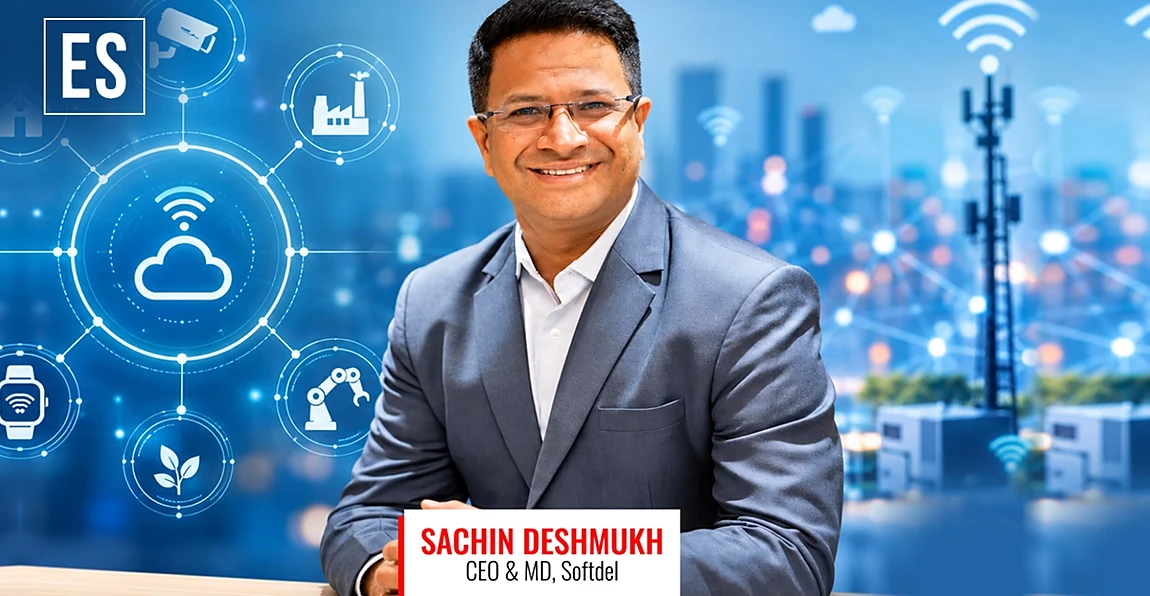
“We believe our time has arrived now as IoT is a strong backbone for AI,” says Sachin Deshmukh, CEO & MD, Softdel, in an interaction with EnterpriseStory.
For Softdel, the connection between IoT and AI starts with data. The company has been focused on connecting physical equipment and extracting information from it, before using cloud and analytics capabilities to derive insights.
“Right from our early days, our focus has always remained on how to connect to an equipment and get the data,” says Deshmukh, adding that the company has always wanted to be solution centric and product-led.
One example, the CEO says, is its IoT platform that monitors the performance of 50,000 industrial chillers of a large corporation spread across different parts of North America. The platform analyses the data generated by the equipment and can identify early signs of potential problems.
“We are at the root of data and enabling this from physical assets,” Deshmukh says.
He says Softdel has evolved from an IoT-focused technology provider into a platform and engineering company spanning consulting, hardware design, embedded systems, cloud, AI and implementation. Its work is concentrated across three verticals: smart buildings, industrial automation, and smart energy.
The company says its experience in handling data from physical assets has also helped it move into AI applications such as workflow automation, predictive and preventive maintenance, and energy optimisation. Deshmukh adds that since data was always the central part of its journey, the company understands how to get, clean this information and build analytics on top of it. “Thus AI became very natural,” he remarks.
The shift also reflects a broader change in how enterprises are approaching AI. While generative AI has brought renewed attention to the technology, industrial applications often depend on data generated from machines, buildings, and other physical infrastructure.
This is where Softdel sees its experience in operational technology and enterprise systems becoming relevant.
Deshmukh says the company operates at the intersection of operational technology, enterprise platforms and AI, allowing it to work on use cases that connect physical assets with enterprise software and analytics.
He believes smart buildings will become even more important as there is a greater focus on having environmentally friendly structures and this can be achieved by deploying IoT platforms to capture data that provides the right inputs. The company entered the smart energy segment around six years ago and has been assisting enterprises in developing efficient systems through IoT.
Given the strides made by AI, Softdel has integrated this into its technology platforms where it is enabling workflow automation, predictive & preventive maintenance, and energy optimisation.
Deshmukh says Softdel’s AI footprint has been very organic given its focus on IoT. This has enabled the company to build enterprise grade AI platforms and applications.
According to Deshmukh, the core differentiation of Softdel has been working very closely with its partners to come out with solutions. “We are always thinking about how to create an environment where we are doing joint solutioning or joint product discovery exercises,” he says.
Softdel has built around 10 IoT labs as part of this initiative. The CEO says its top 15 customers have remained with the company for more than a decade, revealing its close customer connection.
Today, for Softdel, North America is its largest market followed by Japan and then Europe. It is also engaged with the Indian market as an extension of its global partnerships, especially with the establishment of global capability centres (GCCs).
Softdel recently launched an AI lab as it looks to invest in terms of building the right technology platforms, train its employees, and in the process help its customers become AI ready.
“This is the time for rapid growth because AI and engineering have a massive potential,” says Deshmukh.