



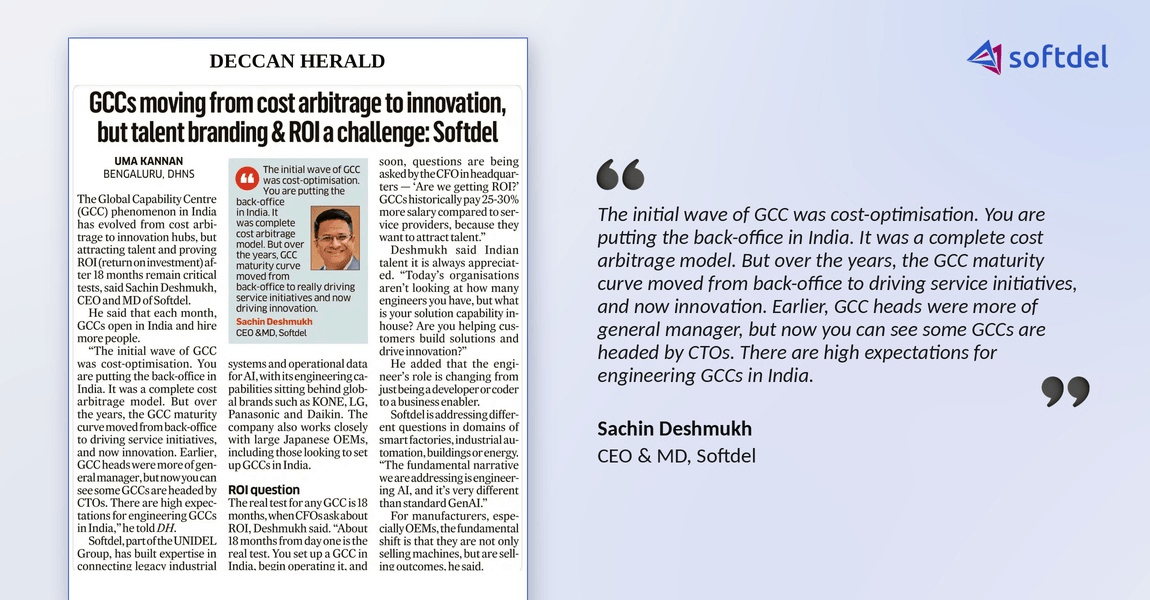
GCCs moving from cost arbitrage to innovation, but talent branding & ROI a challenge: Softdel
Softdel, part of the UNIDEL Group, has built expertise in connecting legacy industrial systems and operational data for AI.
He said that each month, GCCs open in India and hire more people.
“The initial wave of GCC was cost-optimisation. You are putting the back-office in India. It was a complete cost arbitrage model. But over the years, the GCC maturity curve moved from back-office to driving service initiatives, and now innovation. Earlier, GCC heads were more of general manager, but now you can see some GCCs are headed by CTOs. There are high expectations for engineering GCCs in India,” he told DH.
Softdel, part of the UNIDEL Group, has built expertise in connecting legacy industrial systems and operational data for AI, with its engineering capabilities sitting behind global brands such as KONE, LG, Panasonic and Daikin. The company also works closely with large Japanese OEMs, including those looking to set up GCCs in India.

ROI question
The real test for any GCC is 18 months, when CFOs ask about ROI, Deshmukh said. “About 18 months from day one is the real test. You set up a GCC in India, begin operating it, and soon, questions are being asked by the CFO in headquarters — ‘Are we getting ROI?’ GCCs historically pay 25-30% more salary compared to service providers, because they want to attract talent.”
Deshmukh said Indian talent it is always appreciated. “Today’s organisations aren’t looking at how many engineers you have, but what is your solution capability in-house? Are you helping customers build solutions and drive innovation?”
He added that the engineer’s role is changing from just being a developer or coder to a business enabler.
Softdel is addressing different questions in domains of smart factories, industrial automation, buildings or energy. “The fundamental narrative we are addressing is engineering AI, and it’s very different than standard GenAI.”
For manufacturers, especially OEMs, the fundamental shift is that they are not only selling machines, but are selling outcomes, he said.