



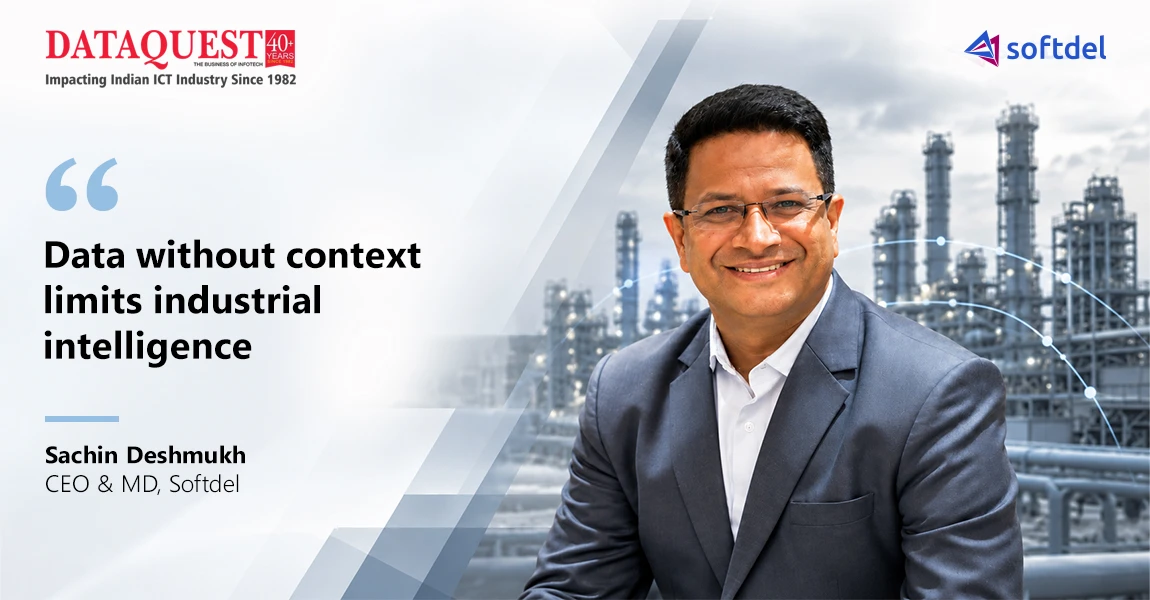
Data without context limits industrial intelligence, says Softdel CEO Sachin Deshmukh
Softdel CEO Sachin Deshmukh explains how contextualised machine data, interoperability and engineering turn industrial AI into measurable operational and business outcomes.
Industrial equipment can generate years of data without giving operators a clear answer about when a machine might fail or why a building is consuming too much energy. The readings exist, but they may sit across disconnected systems, lack context, or come from equipment that was never designed to communicate with newer platforms.
For Softdel, a UNIDEL company specialising in intelligent automation and digital engineering, making that data usable is central to the industrial AI opportunity. The company sees its role expanding from connecting assets and collecting information to helping customers interpret it and take action.

In an interview with Dataquest, Sachin Deshmukh, CEO & Managing Director, Softdel, discusses what has changed in customer demand, why interoperability remains difficult, and how operational improvements can support sustainability. He also explains how Softdel balances customer-owned intellectual property with reusable technology and where it will continue to rely on partners.
What makes Softdel’s AI strategy more than a rebranding, and how much business does AI-led work contribute?
I would actually challenge the term “AI readiness” because it can make this sound like we have taken what Softdel was doing for years and simply put an AI label on it. That is not what has happened.
The underlying capabilities -connectivity, embedded engineering, protocols, IT/OT integration, device data and product engineering – have been part of Softdel for many years. What has changed over the last two to three years is what customers want to do with those capabilities. Earlier, the conversation was largely about connecting devices, building products, integrating systems and making data available. Increasingly, customers are asking: Can we predict a failure? Can we optimise energy? Can we identify an anomaly? Can we automate a decision? Can we make the product itself more intelligent?
That is changing where we create value. We are moving from connecting and collecting data to contextualising it, applying intelligence and increasingly enabling action. I also would not look at AI-led revenue as a completely separate bucket from our traditional business. Much of this work sits within larger product-engineering and IoT engagements. A customer may come to us for product engineering, and the engagement increasingly includes data engineering, analytics, machine learning or intelligent features. So, drawing a clean line between “AI revenue” and “non-AI revenue” can be misleading. What is genuinely new is not that we suddenly started doing AI. AI is changing the engineering problems our customers are asking us to solve and the level at which they want us to participate.
Our product, EdificeDX is a good example. It builds on our longstanding expertise in building systems, equipment data and interoperability, but adds intelligence to move from monitoring towards optimisation and action. It brings together decades of Softdel know-how in connecting equipment, communication protocols, machine data and engineering into an intelligence layer.
So, I see this as an evolution, not a rebranding. We are taking capabilities built over two decades and moving further up the value chain towards operational intelligence at the intersection of physical assets, engineering, data and intelligence.
What keeps industrial data trapped, and what must be fixed before AI can deliver value?
I don’t think there is one universal bottleneck. Industrial data is often trapped across multiple layers of the technology stack, and the starting point depends on the asset, the environment and, most importantly, what the customer is trying to achieve.
We normally start with the use case and work backwards. What is the customer trying to improve: energy consumption, predictive maintenance, asset performance, quality or something else? Once we understand that, we look at what is required to make that outcome possible.
The challenge can exist at several levels. A customer may have legacy equipment that cannot easily communicate with modern systems. They may have proprietary protocols that restrict access to data. They may have connectivity but poor-quality or inconsistent data. Or they may have good data but not enough context to understand what it actually means. In brownfield environments, cybersecurity and the economics of retrofitting also matter.
So, the real challenge is not simply collecting data. It is getting from physical assets to trusted, contextualised and usable operational data. For example, having a temperature reading is one thing. Knowing which piece of equipment it belongs to, what operating condition it represents, whether it is within a normal range and how it relates to the rest of the system is much more valuable. That context is what turns data into operational intelligence.
This is why we don’t believe customers should necessarily replace perfectly functional legacy assets just to make them AI-ready. Often, there is significant value in connecting what they already have and making that data usable.
At Softdel, we work across the chip-to-cloud journey, from devices and connectivity through telemetry, IT/OT integration and data contextualisation, and then into analytics and intelligence. But we don’t assume every customer needs every layer fixed. We identify where the actual gap is and work backwards from the desired outcome.
So, if you ask me what needs to be fixed before AI enters the conversation, I would say the data foundation and the operational context. Once you have trusted, contextualised data flowing reliably from the physical environment, AI becomes much more useful. Without that foundation, you are often just putting AI on top of another data problem.
Why does interoperability remain difficult despite open standards, and do customers see it as a strategic investment?
I would not say the industrial IoT market has failed to standardise. There has been significant progress with open protocols and standards. But interoperability is not something you solve once and then move on from. The reality is that buildings and industrial environments have equipment from different generations, vendors and technology stacks, and all of these continue to evolve. Even when two systems support the same standard, there can still be differences in implementation, configuration and how the data is exposed.
That is why we continue to see a need for interoperability work. Our Connect-a-thon, for example, was less about proving that standards do not work and more about bringing OEMs together to test how equipment actually communicates in a real-world environment. The objective is to make interoperability more practical and predictable for customers.
Commercially, I think the perception is also changing. Customers may not always say, “I want to buy interoperability.” What they really want is for their equipment and systems to work together, to avoid being locked into one ecosystem, and to be able to add or change technologies without having to redesign everything around them.
So, they may still see the immediate spend as an integration cost, but the business value is increasingly in flexibility, scalability and protecting the investment they have already made.
For Softdel, that makes interoperability much more than simply connecting two systems. We need to understand the equipment, protocols and platforms involved and make that communication reliable and usable.
This becomes even more important as AI and analytics are introduced into these environments. You cannot create meaningful intelligence if the underlying systems cannot exchange the right data in the right context. So, I see interoperability evolving from being largely an integration problem to becoming an enabler of operational intelligence. The question is no longer simply, “Can these systems connect?” It is, “Can we make the data from these systems work together well enough to drive better decisions and outcomes?” That is where we see the real opportunity.
Where is industrial AI delivering measurable returns, and how repeatable are those gains?
For Softdel, the business case is ultimately tied to the customer’s operating environment and the problem they are trying to solve. Customers do not invest in AI because it is AI; they invest because it can improve an economic or operational outcome.
Today, the strongest business cases we see are around energy optimisation, asset performance, predictive maintenance, and reducing operational inefficiency or downtime. Sustainability is increasingly becoming part of that business case rather than a separate objective.
We have seen some tangible outcomes. In one energy engagement, an intelligent BESS platform enabled up to 2x reduction in annual energy costs, while reducing equipment run hours by around 20% across more than 50 sites. In another engagement with an industrial HVAC OEM, AI-enabled predictive maintenance helped deliver approximately a 30% reduction in maintenance costs and around a 15% improvement in technician productivity.
But I would be careful about suggesting that these percentages are standard outcomes. AI does not automatically produce a 30% saving. The actual improvement depends on the equipment, operating environment, baseline performance, quality of data and, importantly, how the customer acts on the insights. What is repeatable is the underlying approach: connect the physical asset, bring together fragmented data, understand the operational context, identify inefficiencies or failure patterns, and enable people or systems to take action. The percentage improvement will vary by environment, but the methodology is highly transferable.
This is also how we think about EdificeDX. The objective is not simply to put an AI layer on top of building data. It is to understand how equipment is operating, identify opportunities to improve energy and asset performance, and increasingly move from visibility to recommendations to action.
That is where sustainability becomes particularly interesting. If you reduce unnecessary energy consumption, improve equipment efficiency or avoid a failure, you are simultaneously improving the economics of the operation and reducing its environmental footprint.
So, for us, the strongest proposition is where operational improvement and sustainability reinforce each other, rather than treating decarbonisation as a standalone technology objective.
How does Softdel balance customer-owned IP with proprietary technology and protect its economics when OEMs own the customer relationship?
I think India is moving from being primarily a delivery destination to becoming a strategic engineering and innovation partner, and Softdel sits firmly within that transition. I have spoken about this evolution of the GCC model across various forums, and I believe we are seeing the same shift reflected in the way global OEMs engage with engineering partners like Softdel.
For us, it is not an either-or choice between building customer-owned IP, being a product-engineering partner, or creating our own reusable technology. Our model deliberately combines all three.
We are not trying to build products that compete with our customers. Our role is to bring engineering depth, domain knowledge and increasingly reusable technology that helps OEMs build and evolve their own products faster. Our teams can be deeply involved across the product lifecycle – from architecture and technology choices through development, validation and ongoing evolution. That is also where we see the GCC model heading. The next generation of GCCs is moving beyond delivery and capacity towards greater ownership of product engineering, technology decisions and innovation.
That shift is important, but it is not entirely new to us. We have been working with global OEMs in this model for many years. At the same time, when we see engineering problems that recur across customers, we build reusable capabilities and proprietary technology around them. EdificeDX is one such example- a solution developed around building and industrial ecosystems, equipment intelligence and energy optimisation that can be applied across environments rather than recreated for every customer.
What is important for us is to deliver higher-value engineering to our customers rather than simply providing engineering capacity. We want to participate earlier in the product lifecycle and bring more domain expertise, IP and technology to the engagement. That is also central to the economics of our model. When we develop deep expertise or technology around a particular domain or problem, we can carry that knowledge into other engagements instead of starting from zero each time. This creates more value for customers while making our own business more scalable.
The fact that an OEM owns the customer relationship or product brand is not a conflict. The customer brings the market, product vision and brand; we bring deep engineering know-how, technology and execution. Our objective is not to own the brand, but to become strategically important to the technology behind it and its continued evolution. So, I would describe Softdel as a strategic product-engineering partner that is progressively building proprietary technology and IP around the industry problems we understand deeply. That is how we see our role in India’s shift from engineering capacity to engineering and innovation leadership.
Which parts of the industrial AI stack will Softdel own, and what will it leave to partners?
Scaling responsibly, for us, also means being selective about where we want to compete.
We are not trying to build our own foundation models, become a hyperscaler, or compete with the large automation platforms and OEMs that already own those ecosystems. We also do not want to spread ourselves across every AI use case simply because it is growing.
Where we see a clear right to win is around the industrial and physical layer. Over the next three to five years, we want to own more of the engineering stack between the physical asset and intelligent applications – device connectivity, protocols, edge, data acquisition and contextualisation, cloud and data platforms, analytics, and the engineering needed to apply AI to real-world systems.
That builds directly on what Softdel already knows. We understand connected assets, machine data, protocols and the engineering challenges of bringing these environments together. We can take that foundation further into predictive and prescriptive applications, and increasingly into assisted or autonomous actions where the use case and level of trust make that appropriate.
EdificeDX is a good example of this direction. It is not about building another generic AI platform. It brings together building and equipment data, understands the operational context, and uses intelligence to drive outcomes such as energy efficiency, asset performance and sustainability. That is the kind of domain-specific intelligence we believe we can build and scale.
At the same time, we will continue to work with hyperscalers for cloud infrastructure and services, automation and building platforms for the control layer, OEMs for products and domain expertise, and AI-model providers where their models are the right fit. We do not need to own every layer to create value.
The opportunity for Softdel is to become the engineering and intelligence layer that connects these ecosystems and makes them work in the real world. That is where we can build differentiated IP, reusable technology and long-term customer relationships, while remaining disciplined about what we choose not to build ourselves. Ultimately, the question for us is not, “How much of the AI stack can Softdel own?” It is, “Which layer do we have a right to win because of our domain expertise, engineering depth and customer relationships?” That is where we intend to focus.