Transforming Niagara-based smart building operations with 30% faster engineering workflows
Summary
To accelerate innovation in intelligent building automation, a global building technology leader partnered with Softdel to modernise and enhance its Niagara Framework integration capabilities for next-generation controllers. The engagement focused on improving interoperability, engineering efficiency, system responsiveness, and long-term scalability by transforming a legacy implementation into a flexible, high-performance, and future-ready integration platform.
Customer Background
A Canada-based innovator with 30+ years of leadership in building automation, the customer delivers sustainable, high-performance solutions across 80+ countries. With a strong focus on intelligent building technologies, the company enables smarter, energy-efficient, and operationally optimized environments across commercial, institutional, and industrial facilities worldwide.
The Challenge
As part of its strategic growth roadmap, the customer aimed to strengthen integration between its proprietary controllers and the Niagara Workbench environment to support the next-gen of intelligent building solutions. However, the existing plug-in faced architectural and scalability limitations, while compatibility with newer Niagara versions demanded significant engineering effort. Fragmented workflows and performance constraints further slowed deployment cycles and increased operational overhead.
These challenges increased engineering effort, delayed feature rollouts, and limited scalability for evolving global smart building integration needs.
The need was clear: move from incremental fixes to a scalable, future-ready integration platform.
Softdel’s Approach: Building a Scalable, Future-Ready Niagara Integration Platform
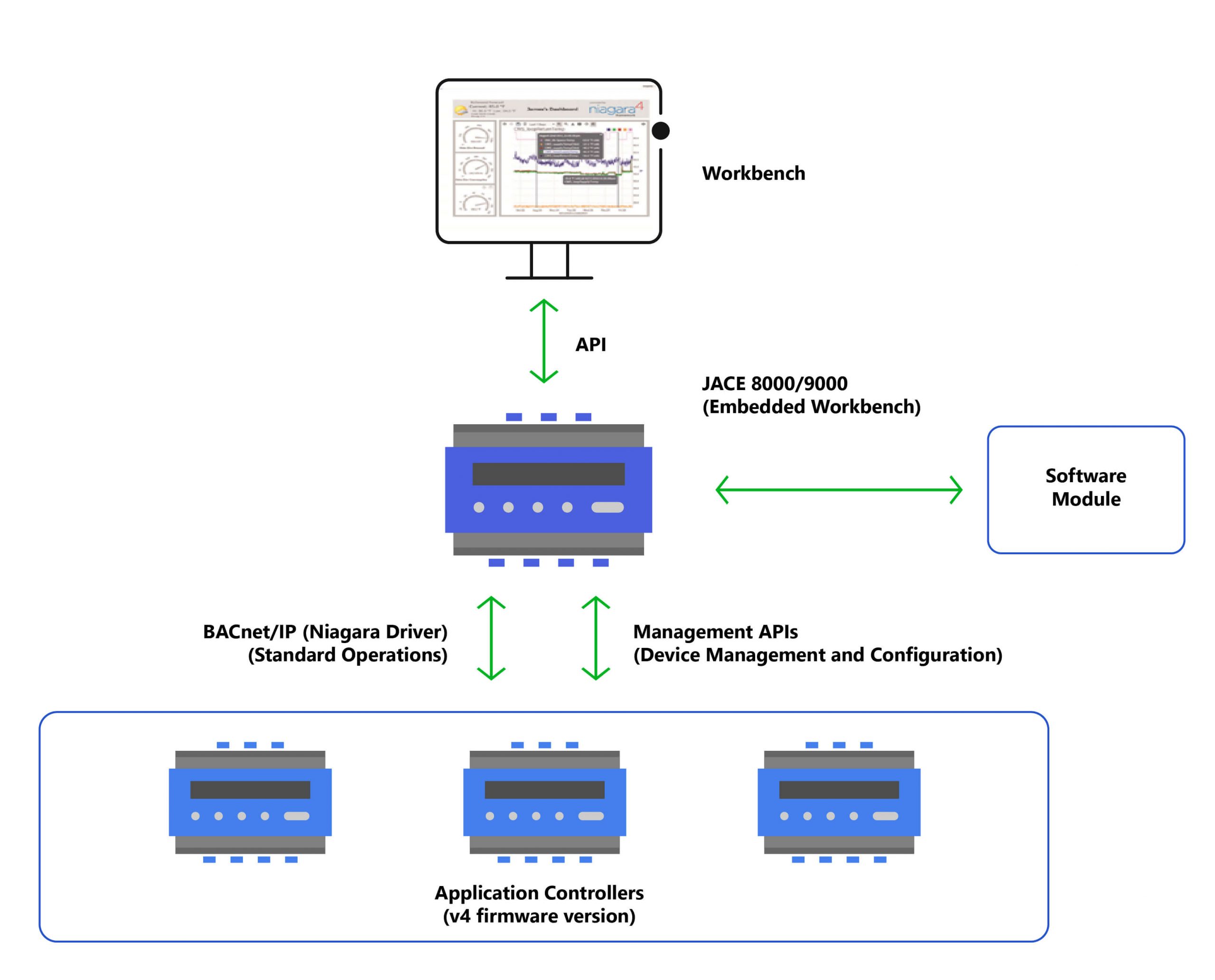
Softdel re-engineered the legacy plug-in into a robust and scalable Niagara extension, enabling seamless integration of proprietary controllers within the Niagara ecosystem. Designed for Niagara 4.15 and JACE 8000/9000, the solution strengthened interoperability, simplified engineering workflows, and established a scalable foundation for future smart building integrations.
Softdel leveraged its deep expertise in building automation, Niagara integrations, and scalable platform engineering to modernise the customer’s ecosystem while ensuring backward compatibility and deployment stability.
This transformation was delivered through a structured engineering approach:
Seamless interoperability and integration: Enabled multi-version dictionary support, unified device visibility, configurable IO objects, and simplified BACnet object management for faster deployment and streamlined operations.
Enhanced configurability and control: Improved network provisioning, programming workflows, and BACnet service capabilities including object create/delete, backup/restore, and reinitialization functions for greater operational flexibility.
Optimised engineering efficiency: Enabled bulk data exchange, enhanced diagnostics, and streamlined configuration management to reduce manual effort and accelerate troubleshooting.
Built for scalability and reliability: Adopted a modular architecture with rigorous testing, backward compatibility validation, and system-level verification to ensure a stable, production-ready release.
Deployment-ready delivery: Delivered a fully documented solution with post-deployment support, enabling seamless adoption and long-term platform evolution.
Operational Impact: Achieved 30% faster engineering workflows through reduced UI latency, streamlined configuration processes, enhanced diagnostics, and reduced manual troubleshooting effort within Niagara environments.
Strategic Impact: Established a scalable and future-ready integration foundation that accelerated rollout of new capabilities, supported evolving Niagara compatibility requirements, and strengthened readiness for global smart building deployments.
Ecosystem Interoperability: Enabled seamless integration of customer controllers within Niagara environments, simplifying onboarding, improving interoperability across controller ecosystems, and enhancing deployment flexibility for scalable smart building operations.